
By Niall Clements, Smaragda Vasileiadi, Francesca Bottan and Togo Yasuda Edited and reviewed by Beline Nyangi, Niall Clements and Togo Yasuda
Media Narratives
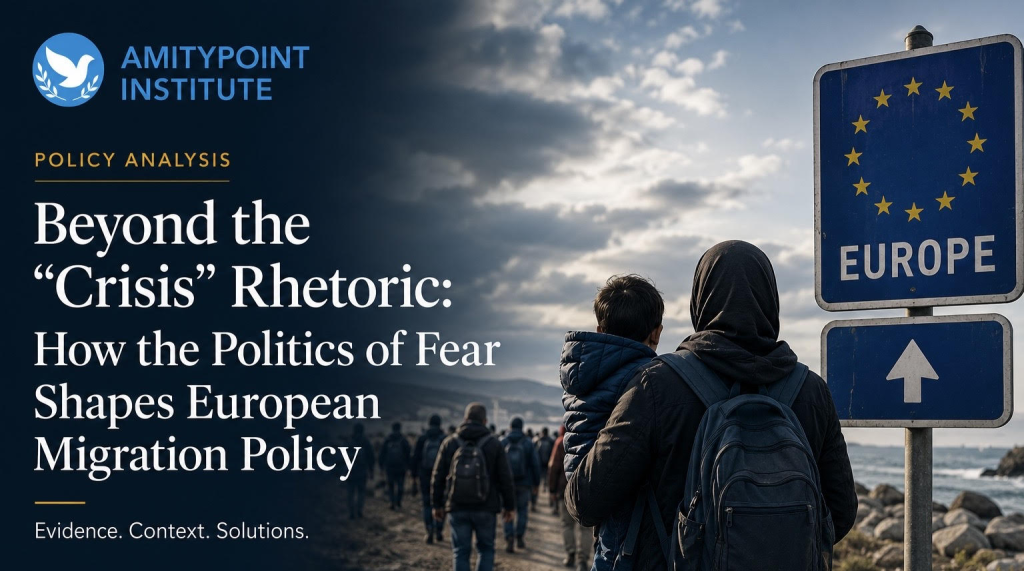
The media space surrounding immigration has consistently become more populated by sensationalist and fear-mongering articles rather than promoting facts, with those fleeing war, persecution, or economic crises being framed as a security threat rather than humanitarian issues. This trend of polarising language, spurred by the 2015 refugee crisis, has not been representative of the decline in immigration seen in the direct years after (Matar, 2017), yet has since been used by the media to continue pushing increasingly anti-immigrant rhetoric to this day.
This vague and generalised depiction is deeply tied to the notion of securitisation. According to the Copenhagen School, there is no objective security issue, rather these are socially constructed through a process. How this is built can be argued, however it is recognized that discourse and therefore speech acts play a large part in this (Leonard & Kaunert, 2022).
The mainstream media is filled with examples of this language, using words like flood, wave, or surge to present migration as a “crisis”, utilising provocative language to suggest a loss of control and spark fear of being overwhelmed (Zaman, 2025). This rhetoric is taken a step further by polarizing and divisive political movements which characterize the situation as an invasion, significantly influencing public opinion and subconscious perceptions of minorities.
This capitalization on immigration and arguably its weaponization by the media through sheer saturation vastly contributes to the negative perceptions of migrants, as statistics on crime or race demographics are often cherry-picked to fit a certain narrative or agenda that these parties want to push. This trend shows how consistent media discourses may create the illusion that these discourses represent widely accepted beliefs and even factual depictions of migrants and how migration influences societies (Fuller, 2024).
In this current media space, more online news and media pages, official or not, exist than ever before, making governments and politicians extremely reliant on the media to garner support for and legitimise policy approaches. Media coverage and perceptions have been proven to exert considerable influence over politics and voting patterns, meaning many politicians are keen to shape their rhetoric in a way that elicits positive coverage in the media, thereby adapting narratives based on different purposes for different venues (Garcés Mascareñas and Pastore, 2025).
Examples of this narrative exist all over Europe, with Nigel Farage in the UK, Geert Wilders in the Netherlands, and Alice Weidel in Germany among others, pushing extreme anti immigration narratives based on misinformation and fearmongering. The propagation of biased or ill-founded information contributes to perpetuating stereotypes and creating an unfavourable environment. As such it jeopardises prospects of societal integration, removing the human element from the plight of these immigrants and strengthening preconceived racist or xenophobic notions (Georgiou and Zaborowski, 2015).
By painting migrants as “others”, politicians and media are able to dehumanise them in the public eye in order to justify the social hierarchy, unequal resource distribution, and systemic discrimination happening every day, while deflecting attention away from domestic policy and governmental failures. Pushing this narrative has proved to be an extremely successful scapegoat to stop people looking within at governmental failures, wasted expenditure, lack of social programmes, and lack of housing construction.
The resulting harsh migration policies that follow are frequently ineffective or backfire because they are not based on a scientific understanding of the nature, causes and consequences of migration. Correcting these narratives to ensure objectivity is difficult as politicians, international organisations, and mass media routinely ignore evidence that challenges dominant narratives or actively distort the truth about migration to fit the narrative they want to push (De Haas, 2024).
Housing Crisis amid Immigration
As mentioned, housing is one of the issues hijacked by populist political actors to further their point against immigration. While in reality, this particular crisis is the result of a systemic supply issue, nowhere more evident than in the Netherlands, where a shortfall of 418,000 homes was registered in 2025. Far-right groups use the lack of available housing to claim migrants are responsible and get priority; however, data shows they only receive 14%, leaving the vast majority for native citizens. Across the EU, social housing represents only around 8% of total dwellings, a share that has declined steadily due to underinvestment and privatisation (ART, 2025), greatly contributing to the housing crisis.
A 2025 paper from The European Federation of National Organisations Working with the Homeless (FEANTSA) observes that 'in an attempt to mask the systemic failures in the housing market, policy makers in many European countries have purposely blamed migrants for this crisis' (FEANTSA, 2025, p.2). This framing has proven electorally potent. In the Netherlands, far-right parties, most notably Geert Wilders' PVV, attributed the housing shortage directly to migrants and asylum seekers, despite waiting lists for public housing being a major issue long before any recent migration surge.
Post-election interviews confirmed that the narrative of 'priority social housing given to immigrants over native Dutch citizens' had motivated right-leaning votes, even though the evidence proves differently (JRC, 2025). The felt consequence of this narrative amplification is friction in local communities (JRC, 2025).
At present, such a division may become even more pronounced if a draft Returns Regulation is passed, which would see the lack of a fixed address as a cause for detention. Effectively this turns what is a humanitarian issue into a security one, propelling years of failed housing policy into a new dimension. The JRC's 2025 Science for Policy report identifies six dominant migration narrative frames in mainstream media: solidarity, humanitarian, economic benefit, pragmatic, threat and crisis. The threat and crisis frames have proven most electorally resonant, precisely because they activate strong negative emotions in audiences that render factual correction ineffective: 'once negative emotions were triggered, factual knowledge could no longer change policy views on immigration' (JRC, 2025, p.21).
Securitization of Immigration
Tackling the issue of migration has been part of the EU’s portfolio since the very first migration crisis in 2005. Frontex, the agency charged with managing the external borders of the European Union has perhaps become the clearest manifestation of the securitisation of migration throughout the past decades. Since 2004 what was a small agency to facilitate coordination between member states, has evolved into an organization aiming to operate its own fleet of vehicles and ships with a standing corps of 10,000 members.
Frontex is also charged with the outgoing flux of migrants; these return flights are organized so that same nationals are staged and collected in a single member state for further travel. Note that this cooperation has at times been the subject of accountability issues, with the agency reticent to take the blame for operations. This in turn affects the legitimacy of the whole organization, in part due to under-regulation, as well as the rather secretive attitude it holds in relations to its public relations (Kalkman, 2020).
The mentioned accountability issues are ever more prominent as Frontex staff are increasingly on the frontline and at risk of violating rights, with calls for them to withdraw from operations in Greece due to reports of human rights violations at its borders, including illegal pushbacks of asylum seekers which goes directly against international and EU law (Fallon, 2022).
The militaristic way in which borders are policed and managed together with categorization of individuals are clear securitisation practices. Some find that the name itself with the inclusion of ‘Front’ leans too heavily into a war and battle connotation, a notion which is reflected by the ‘war on migration’ and use of drones and satellites. Neither the European Parliament nor the Commission seem to agree on their position with Frontex, the former having no real oversight capabilities, depending on third parties to implement its provisions, while the latter has the ability to conduct direct oversight (Zhong & Carrapico, 2024).
A European Answer
The EU is taking steps to rectify such issues and the broader immigration problem, with an aim to centralize what is otherwise a confused net of bilateral agreements which involve 17 member states as of 2024 (Migration and Home Affairs, 2025). This would be achieved through the EU Pact on Migration and Asylum; this new set of rules aims to create a common asylum system, stronger border screening, clearer responsibility rules, and a permanent solidarity mechanism so that no Member State is left alone under pressure (Migration and Home Affairs, 2024). Overall, it focuses on aims such as solidarity, responsibility, border management, and human rights.
Additionally, it embeds migration within broader external partnerships, including anti smuggling cooperation, legal pathways such as Talent Partnerships, and stronger readmission cooperation with third countries (Migration and Home Affairs, 2024). Even though this new Pact includes safeguards for people needing protection, harmonized reception standards, and asylum rights guarantees; NGOs and humanitarian organisations have expressed concerns. They criticise it for its potential greater detention at borders including families with children, its fewer opportunities for fair asylum procedures, and the concerns of increased pushbacks and outsourcing asylum to third countries (International Rescue Committee, 2024).
Environmental and legal realities highlight that EU Member States exercise their sovereignty, as support for the EU Pact is not homogeneous across EU countries (Radjenovic, 2025). Similarly, migration continues to be a highly politicised debate, and experts doubt whether the rules can genuinely protect rights while managing complexity (Radjenovic, 2025). Moreover, this new EU Pact brings numerous externalisation risks from the 2016 EU-Turkey statement to the 2024 EU-Egypt agreement (Vues d’Europe, 2025), as we have seen the EU increasingly delegating migration policy to third countries (Vues d’Europe, 2025). We can acknowledge the EU to have the EU Pact as its migration framework, which portrays strong qualities and aims on paper, but brings numerous risks and concerns about human rights violations.
Conclusion
Overall, migration has not become a security issue in any empirical sense. What has changed is that the perception of migration as a security threat is being deliberately constructed and institutionally embedded, crowding out the humanitarian framework that the evidence continues to demand. The increase in misinformation in the modern day, with much more exposure to agenda-driven media and the dangers of generative AI, emphasises the need for a comprehensive approach to better inform citizens, address concerns about migration and counter disinformation (European Commission, 2025b).
Bibliography
Council of the European Union, Analysis and Research Team (ART). (2025). One Roof, Many Realities: Europe's Complex Housing Crisis. General Secretariat of the Council of the European Union.
De Haas, H. (2024). Changing the Migration Narrative: On the Power of Discourse, Propaganda and Truth Distortion. Working Paper No. 181. Institute of Social Studies.
European Commission. (2025b). Public discourse on migration shaped by misinformation and conspiracy theories. The Joint Research Centre: EU Science Hub.
European Federation of National Organisations Working with the Homeless (FEANTSA). (2025). FEANTSA Position on Migration. Position Paper.
Fallon, K. (2022). EU border agency accused of serious rights violations in leaked report. The Guardian.
Fuller, J.M. (2024). Media discourses of migration: A focus on Europe. Language and Linguistics Compass, 18(4).
Garcés-Mascareñas, B. & Pastore, F. (2025). The making of migration narratives: understanding processes and gauging impacts. Journal of Ethnic and Migration Studies, 51(16).
Georgiou, M. & Zaborowski, R. (2015). Media coverage of the ‘refugee crisis’: A cross-European perspective. Council of Europe.
International Rescue Committee. (2024). What is the EU Pact on Migration and Asylum? Legal Explainer.
Joint Research Centre (JRC), European Commission. (2025). Navigating Migration Narratives: Research Insights and Strategies for Effective Communication. European Commission.
Kalkman, J. (2020). Frontex: A Literature Review. International Migration, 59(1).
Leonard, S. & Kaunert, C. (2022). The Securitisation of Migration in the European Union: Frontex and its Evolving Security Practices. Journal of Ethnic and Migration Studies, 48(6).
Migration and Home Affairs. (2024). Pact on Migration and Asylum. European Commission Guidelines.
Migration and Home Affairs. (2025). Migration cooperation with third countries. European Migration Network Annual Overview.
Matar, D. (2017). Media Coverage of the Migration Crisis in Europe: a Confused and Polarized Narrative. IEMed Mediterranean Yearbook.
Radjenovic, A. (2025). Implementation of the EU pact on migration and asylum. European Parliamentary Research Service.
Vues d’Europe. (2025). EU - third countries agreements on migration. Legal Analysis Hub. Zaman, K. (2025). Media & Migration: How Narratives Shape Europe’s Future. European Relations Analytics.
Zhong, Y. & Carrapico, H. (2024). The Development of Frontex: Integration through Supranationalism. European Politics and Society, 25(2).