
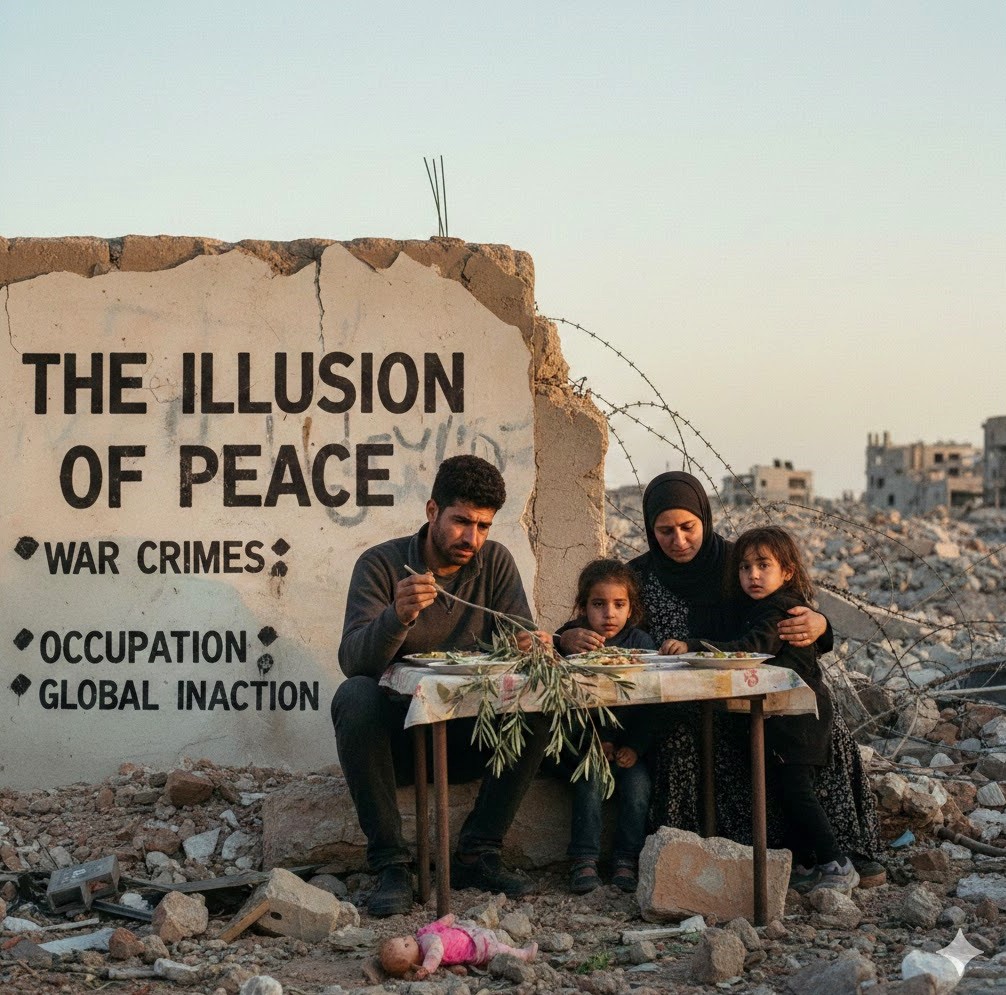
By Niall Clements, Amal Mansoor, Smaragda Vasileiadi, Francesca Bottan, and Togo Yasuda
Edited and reviewed by Beline Nyangi.
Introduction
The conflict and injustices in Palestine span nearly a century, tracing back to the 1930s and the Zionist movement’s aim to establish a Jewish state in Palestine (United Nations, 2025). During the 1948 war, Zionist paramilitary forces, including Haganah, played a central role in what Palestinians refer to as the Nakba. This period involved the mass displacement of Palestinians, documented massacres, dispossession of land and property, and the dismantling of social and political structures, alongside the suppression of culture, identity, and national aspirations (Abu-Laban and Bakan, 2022). These events culminated in the establishment of the State of Israel on 14 May 1948.
Subsequent decades witnessed repeated violence, including the Kafr Qasim Massacre (1956), the Six-Day War (1967), and the Sabra and Shatila Massacre (1982) (Council on Foreign Relations, 2024). The current war in Gaza continues this trajectory. Despite multiple ceasefire agreements, large-scale hostilities persist, alongside serious allegations of war crimes, crimes against humanity, and genocide.
This article assesses alleged violations committed in the context of the armed conflict and prolonged occupation of Palestinian territory. It draws upon international legal obligations, treaty frameworks, and customary international law, as well as findings from the UN Special Rapporteur, proceedings before the International Court of Justice (ICJ) and International Criminal Court (ICC), and documentation from Amnesty International. It further examines accountability gaps, the role of international and regional actors, institutional limitations, the risk of regional escalation, and the structural barriers to durable peace.
Lack of Accountability for War Crimes
Israel is party to several major international treaties concerning international crimes. It ratified the Genocide Convention in 1950 and the Fourth Geneva Convention in 1951, assuming obligations to prevent genocide and protect civilians during armed conflict and occupation. It is also party to the Convention against Torture (1991) and the International Convention on the Elimination of All Forms of Racial Discrimination (1979).
Although Israel has not ratified the Rome Statute of the ICC, it remains bound by customary international law and peremptory norms prohibiting genocide, apartheid, and racial discrimination.
Amnesty International (2024) reports widespread violations of international humanitarian and human rights law, including large-scale civilian casualties, mass displacement, destruction of essential infrastructure, obstruction of humanitarian aid, arbitrary detention, and settlement expansion in occupied territory. It further characterises Israeli policies toward Palestinians as constituting apartheid under international law.
The ICJ has addressed state responsibility under the Genocide Convention and issued provisional measures requiring Israel to prevent acts that could fall within the Convention’s scope. In July 2024, the Court found Israel’s continued occupation of Palestinian territory unlawful under international law (Amnesty International, 2024).
The ICC, addressing individual criminal responsibility, has asserted jurisdiction over crimes committed on the territory of Palestine since June 2014 (Panel of Experts, 2024). In November 2024, arrest warrants were issued for senior Israeli and Hamas officials on charges including war crimes and crimes against humanity (Amnesty International, 2024). These developments underscore that international criminal law applies to both state and non-state actors.
However, enforcement remains uncertain. The ICC relies on state cooperation to execute warrants, and geopolitical alliances influence compliance. The gap between legal determinations and accountability remains significant.
UN Special Rapporteur Francesca Albanese (2025) has argued that third states may incur responsibility where political, military, or economic support enables violations. She emphasises that all states have erga omnes obligations to prevent genocide and uphold the right to self-determination.
The Role of International and Regional Actors
The Israel–Palestine conflict involves influential external actors, notably the United States, Egypt, and Jordan.
The United States serves as the primary external mediator. It has supported ceasefire negotiations and advanced proposals through the UN Security Council, including the establishment of an International Stabilization Force in Gaza (United Nations, 2025). While presented as a framework for reconstruction and security, critics argue that repeated U.S. vetoes of ceasefire resolutions undermine perceptions of neutrality (Al Jazeera, 2025).
Egypt plays a central regional role, brokering ceasefires and facilitating humanitarian access through Rafah. It has supported reconstruction initiatives and intra-Palestinian dialogue (Maziad, 2025; Fouly, 2025). However, Egypt must balance security coordination with Israel and regional political pressures.
Jordan similarly balances its 1994 peace treaty with Israel and strong domestic pro-Palestinian sentiment (Yitzhak, 2025). While advocating a two-state solution, it maintains security coordination with Israel (Milliken, 2025).
These actors shape negotiations and reconstruction efforts, yet their involvement largely prioritises short-term stabilisation over structural resolution of occupation and sovereignty.
International Institutions and Their Limits
The United Nations and the ICC were designed to uphold peace and justice, yet both face structural constraints.
The UN Security Council’s veto system allows any permanent member to block substantive resolutions. This structure reflects post-World War II power dynamics rather than contemporary realities. In June 2025, a draft resolution calling for a permanent ceasefire failed due to a U.S. veto (Mishra, 2025). Such outcomes illustrate the limits of collective action where geopolitical interests prevail.
The ICC represents the first permanent international criminal court, but it lacks enforcement authority. Several major powers are not parties to the Rome Statute. The Court depends entirely on state cooperation to execute arrest warrants (Kent et al., 2024). This reliance creates tension between legal authority and political reality.
Without political will, institutional mechanisms alone cannot ensure accountability.
Risk of a Wider Middle East War
Although often framed as a bilateral conflict between Israel and Hamas, the war carries broader regional implications. Hamas operates within a network aligned with Iran, often referred to as the ‘Axis of Resistance’, which includes Hezbollah in Lebanon and the Houthis in Yemen (Slavin, 2025). Since October 2023, thousands of cross-border incidents have occurred (Mehvar, 2025).
The brief 2025 confrontation between Israel and Iran demonstrated the fragility of regional stability. Instability in Lebanon and Syria further increases the risk of escalation (Dall’Asta, 2026). At the same time, regional powers such as Saudi Arabia have sought to contain tensions to preserve broader strategic interests (Tejeda, 2026).
While a wider war is not inevitable, the regional environment remains volatile.
Why Peace Cannot Endure Under Occupation
The prolonged occupation of Palestinian territory remains central to the conflict. Israeli settlement expansion in the West Bank continues despite Article 49 of the Fourth Geneva Convention, which prohibits the transfer of an occupying power’s civilian population into occupied territory (ICRC, 2022).
Past peace initiatives, including the Oslo Accords, created interim governance structures but did not resolve final status issues. Political fragmentation and repeated cycles of violence have eroded trust. The First Intifada demonstrated the potential of grassroots mobilisation to shift diplomatic momentum (King, 2007), yet subsequent developments stalled long-term progress.
Ceasefires in Gaza have repeatedly paused hostilities without addressing structural drivers of conflict. Without resolution of occupation, sovereignty, security arrangements, and political rights, peace risks remaining temporary rather than transformative.
Lasting peace requires credible accountability mechanisms, meaningful political reform, and recognition of both Palestinian self-determination and Israeli security concerns. Without structural change, ceasefires may continue to function as pauses in a recurring cycle rather than foundations for durable peace.
References
Abu-Laban, Y. and Bakan, A.B. (2022) The Nakba and the Struggle for Palestinian Rights. London: Routledge.
Albanese, F. (2025) Report of the Special Rapporteur on the Situation of Human Rights in the Palestinian Territories Occupied since 1967. United Nations Human Rights Council. Available at: https://www.ohchr.org (Accessed: 12 February 2026).
Al Jazeera (2025) ‘US veto blocks UN ceasefire resolution on Gaza’. Al Jazeera, 4 June. Available at: https://www.aljazeera.com (Accessed: 12 February 2026).
Amnesty International (2024) Israel/Occupied Palestinian Territory: Evidence of War Crimes and Crimes against Humanity. London: Amnesty International. Available at: https://www.amnesty.org (Accessed: 12 February 2026).
Council on Foreign Relations (2024) The Israeli-Palestinian Conflict: A Timeline. Available at: https://www.cfr.org (Accessed: 12 February 2026).
Dall’Asta, G. (2026) ‘Regional spillover risks in Lebanon and Syria’. Middle East Policy Journal, 33(1), pp. 45–60.
Fouly, M. (2025) ‘Egypt’s mediation role in Gaza ceasefires’. Carnegie Middle East Center, 12 March. Available at: https://carnegie-mec.org (Accessed: 12 February 2026).
International Committee of the Red Cross (ICRC) (2022) Geneva Convention IV Relative to the Protection of Civilian Persons in Time of War. Geneva: ICRC. Available at: https://www.icrc.org (Accessed: 12 February 2026).
Kent, A., Heller, K. and Akande, D. (2024) ‘The enforcement gap at the International Criminal Court’. Journal of International Criminal Justice, 22(3), pp. 567–589.
King, M.L. (2007) A Quiet Revolution: The First Palestinian Intifada and Nonviolent Resistance. New York: Nation Books.
Maziad, M. (2025) ‘Rafah crossing and Egypt’s strategic balancing act’. Arab Center Policy Brief, 8 February. Available at: https://arabcenterdc.org (Accessed: 12 February 2026).
Mehvar, S. (2025) ‘Escalation patterns along Israel’s northern border’. International Crisis Group Briefing, 21 April. Available at: https://www.crisisgroup.org (Accessed: 12 February 2026).
Milliken, D. (2025) ‘Jordan navigates domestic pressure and regional diplomacy’. Reuters, 17 May. Available at: https://www.reuters.com (Accessed: 12 February 2026).
Mishra, P. (2025) ‘UN Security Council fails to adopt Gaza ceasefire resolution after US veto’. UN News, 4 June. Available at: https://news.un.org (Accessed: 12 February 2026).
Panel of Experts (2024) Jurisdiction of the International Criminal Court in Palestine. The Hague: International Criminal Court. Available at: https://www.icc-cpi.int (Accessed: 12 February 2026).
Slavin, B. (2025) ‘Understanding Iran’s Axis of Resistance’. Atlantic Council Issue Brief, 10 January. Available at: https://www.atlanticcouncil.org (Accessed: 12 February 2026).
Tejeda, A. (2026) ‘Saudi Arabia and regional de-escalation strategies’. Middle East Institute Analysis, 14 February. Available at: https://www.mei.edu (Accessed: 12 February 2026).
United Nations (2025) United Nations Security Council Resolutions on the Situation in the Middle East. New York: United Nations. Available at: https://www.un.org (Accessed: 12 February 2026).
Yitzhak, R. (2025) ‘Jordan’s foreign policy and the Palestinian question’. Foreign Policy Analysis Review, 19(2), pp. 112–128.
By Niall Clements, Amal Mansoor, Smaragda Vasileiadi, Francesca Bottan, and Togo Yasuda
Edited and reviewed by Beline Nyangi.