
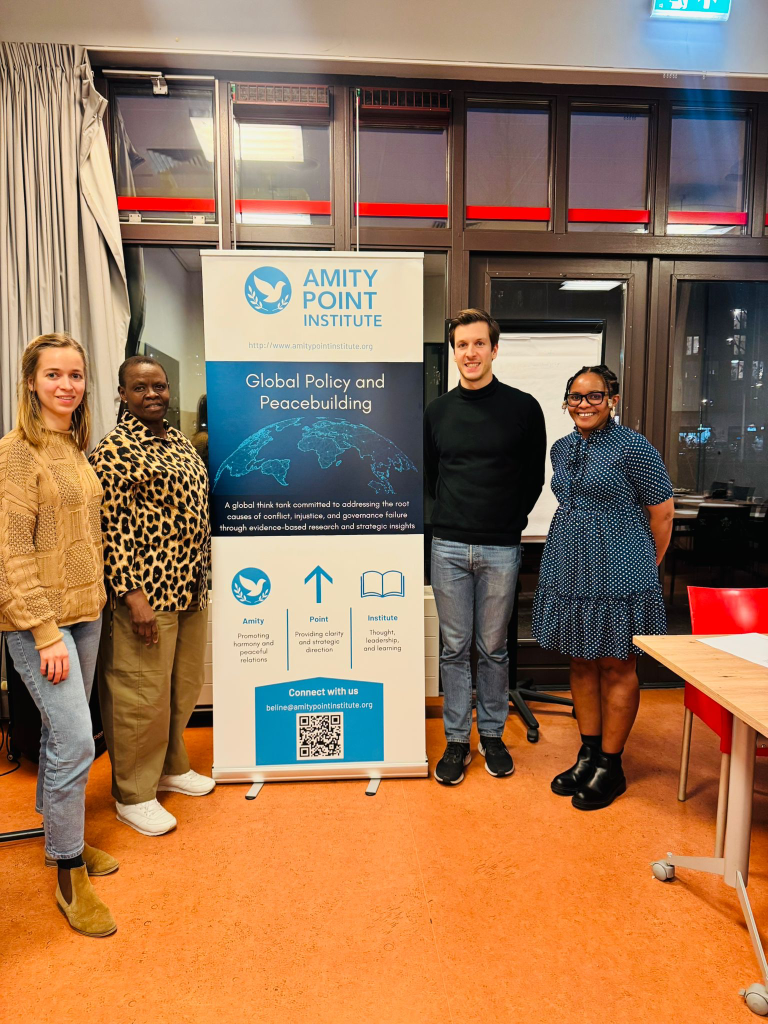
On 20 February 2026, participants gathered at the AmityPoint Institute in Amsterdam for a workshop titled Why Peace Efforts Struggle. It was not a space for debate, policy simulation or quick fixes. It was a space for reflection.
From the beginning, the tone was clear. We were not there to produce a peace plan for Israel–Palestine, Sudan, Ethiopia or Ukraine. We were there to look carefully at why peacebuilding efforts so often fall short. We were there to examine patterns, question assumptions and sit with the uncomfortable trade offs that shape real world negotiations.
The workshop opened with a simple but disarming question. When you hear the word peace, what feels missing in current conflicts?
The answers were thoughtful and deeply personal. Some spoke about the absence of justice. Others mentioned the lack of trust. A few reflected on the distance between diplomatic language and daily survival. That distance would become a central theme throughout the day.
The Story We Returned To
Before turning to geopolitical analysis, we were introduced to a story collected by the Norwegian Refugee Council during the war in Sudan.
In Khartoum North, a young man named Munzer begins each day with a one hour walk. He pushes a wheelbarrow through streets that still echo with gunfire. His family has not had running water for two weeks. The pipes are cut. The taps are dry. The only reliable source of water is a hospital well.
Every day, Munzer fills heavy containers and pushes them back home. The road is long, but more than that, it is dangerous. Armed men can appear without warning. People fetching water know they may be targeted.
At the same time, ceasefires are announced. Agreements are drafted. International actors speak of windows of opportunity.
But for Munzer, peace is measured differently. It is measured in litres of water. It is measured in whether the road is safe. It is measured in whether his wife is protected and whether his children can sleep through the night.
That story stayed with us. It forced a quiet but powerful question. If peace processes do not change Munzer’s daily reality, what kind of peace are we building?
Israel and Palestine: When Negotiation Becomes Routine
The first case study focused on Israel and Palestine. Participants described a prolonged conflict shaped by occupation, territorial claims and profound asymmetry of power.
One of the early observations was the difficulty of understanding what is happening on the ground. Media narratives differ dramatically depending on where one looks. Arabic media often centers the Palestinian experience. Western coverage frequently emphasizes Israeli security concerns. For outsiders, it can feel almost impossible to grasp a shared reality.
We reflected on decades of negotiations, including the Camp David Summit and subsequent diplomatic efforts. Talks have come and gone. Ceasefires have been declared. Yet a number of participants felt that the underlying power structures have remained largely intact.
Several factors were repeatedly mentioned. There is a clear imbalance of power. Palestinian political leadership is fragmented. International involvement is shaped by strategic alliances, particularly the role of the United States. Accountability mechanisms are weak or inconsistent.
A question emerged that resonated throughout the room. Can negotiations truly succeed if the power structure itself remains unchanged?
Some participants suggested that in such conditions, negotiation risks becoming a ritual. It creates the appearance of movement while realities on the ground continue to harden. Settlement expansion, mistrust and cycles of violence deepen even as talks continue.
There was no easy consensus about solutions. Ideas ranged from stronger international accountability to grassroots reconciliation efforts that bring ordinary Israelis and Palestinians into dialogue. Yet the overall mood was sober. Many felt that under current political conditions, durable peace remains unlikely.
Sudan: Stability Without Legitimacy
The conversation then returned to Sudan, this time through the lens of structure and power.
Since April 2023, fighting between the Sudanese Armed Forces and the Rapid Support Forces has devastated the country. What began as a struggle over state control after civilian mobilization for democratic change escalated into a violent power contest layered onto long standing institutional fragility.
Participants identified recurring drivers. Control over resources, particularly gold. Weak state institutions. Military dominance over civilian politics. External actors pursuing their own interests.
Elite negotiations and ceasefires have repeatedly stalled or collapsed. The reason, many argued, is that those who control weapons and resources retain leverage, while civilians remain sidelined.
This led to a critical question. What happens when stability is prioritized over legitimacy?
If agreements are designed primarily to stop immediate violence between armed actors, but fail to include civilians or address structural injustice, they may calm the situation temporarily. Yet they risk entrenching the very conditions that produced the conflict.
Participants also reflected on global attention. Compared to Israel and Palestine or Ukraine, Sudan receives far less sustained international focus. That disparity affects diplomatic pressure, humanitarian response and political urgency.
In this context, Munzer’s daily walk for water felt even more urgent. Peace cannot be reduced to elite arrangements if ordinary life remains defined by fear and deprivation.
Ethiopia: Peace Without Resolution
The case of Ethiopia centered on the war in Tigray and the 2022 Pretoria Agreement, which significantly reduced large scale violence between federal forces and the Tigray People’s Liberation Front.
On paper, the agreement marked an important turning point. Yet participants were cautious. Deep historical grievances remain unresolved. Ethiopia’s political history includes strong centralization, ethnic federal tensions and militarized governance. Key stakeholders were excluded from negotiations. Humanitarian systems were devastated.
The question posed was simple but profound. Is reduced violence enough to sustain peace?
Most participants felt that while reduced violence is essential, it is not sufficient. Without accountability, inclusion and trust building, agreements risk becoming temporary pauses rather than durable solutions.
Peace, in this view, must address root causes. Otherwise, conflict may simply reappear in another form or location.
Ukraine: The Dilemma of Negotiation
The war in Ukraine brought geopolitical tensions into sharper focus. Since the full scale invasion by Russia in February 2022, questions of sovereignty, territorial integrity and global security have dominated international discourse.
Early diplomatic efforts collapsed over disputes concerning Crimea, neutrality, demilitarization and alliance commitments. Mediation efforts have faced accusations of bias and limited leverage.
Participants wrestled with a difficult ethical dilemma. When does negotiation protect peace and when does it entrench injustice?
If ending violence requires accepting territorial loss achieved through force, does that legitimize conquest. If war continues in the name of justice, how many lives are lost in the meantime.
Beyond strategy, participants spoke about psychological harm. Displacement, trauma, and the collapse of long held aspirations have left deep scars. Peace must account for these invisible wounds, not only territorial lines.
Patterns That Emerged
As discussions moved from individual cases to broader reflection, several patterns became visible.
Power asymmetry shapes who enters the room and who sets the agenda. Elite actors often negotiate among themselves, while civilians remain outside. International actors bring strategic interests that influence outcomes. Peace is frequently defined as the absence of violence rather than the presence of justice. Accountability is postponed in the name of stability.
Participants also identified uncomfortable questions that peace processes tend to avoid. Do powerful states genuinely seek justice or do they prioritize strategic advantage? Why do some conflicts command global attention while others remain peripheral? What message is sent when aggressors face limited consequences?
These questions did not lead to neat answers. They led to deeper reflection.
What Peace Means in Daily Life
In the final segment of the workshop, we returned once more to Munzer.
After hours of discussing power, mediation, and structural reform, the facilitator asked a simple question. What would peace need to mean in his life?
Participants spoke quietly but clearly. Peace would mean that he can walk to fetch water without fear. That water flows in his home. That his children are safe from recruitment or violence. That he can earn a living without bribery or coercion. That his suffering is acknowledged, not erased.
In that moment, the distance between diplomatic language and daily survival felt unmistakable.
If violence decreases but trust never returns, is that peace. If accountability is indefinitely postponed, what message does that send to those who suffered. If power structures remain intact, does peace resolve conflict or merely manage it.
The workshop did not end with a declaration. It ended with humility.
Participants left questioning their own assumptions. Some reconsidered the balance between inclusion and speed. Others reflected on the tension between stability and justice. Many carried with them the image of a young man pushing a wheelbarrow under a sky still marked by war.
At AmityPoint, the conversation does not end when the workshop closes. If peace is to be meaningful, it must extend beyond agreements and into daily life. It must reach people like Munzer.
Anything less may calm a conflict for a moment. But it will not build peace that lasts.