
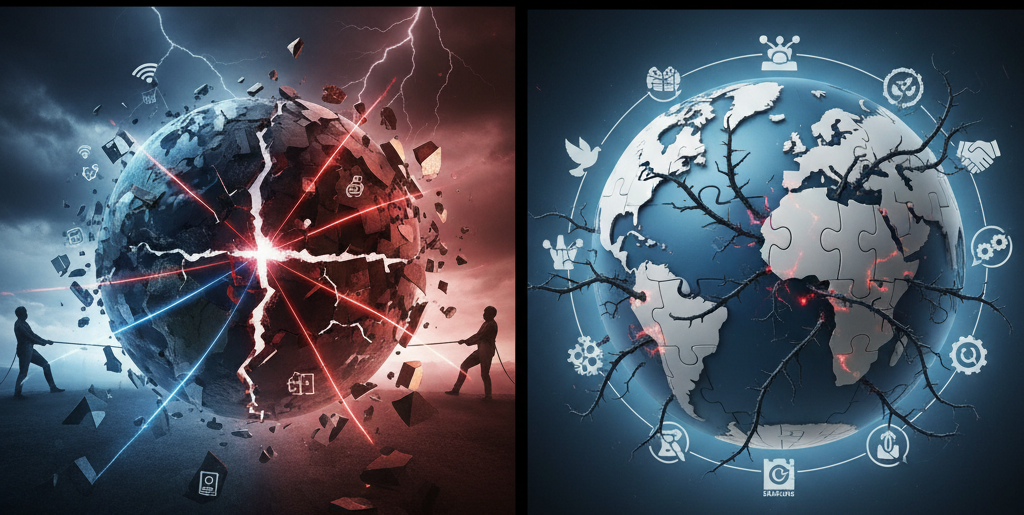
Over the past decade, polarization has evolved from a domestic political issue into a global challenge that threatens the fabric of social cohesion and the stability of international systems. The world’s leading democracies are increasingly divided. This is by ideology, identity, and perceptions of belonging. These divisions now reverberate beyond national borders. When societies split along hardened lines, their ability to manage crises, govern effectively, and maintain security diminishes.
Polarization and Its Security Consequences
Polarization corrodes the fundamental glue that holds societies together: trust. When large segments of a population believe they are ignored or vilified, their trust in democratic institutions declines. This loss of confidence has a measurable impact on state capacity, making it harder for governments to implement policies, enforce the rule of law, and sustain legitimacy (Denter, 2025). The United States offers a vivid example. The 2023-2024 House Speaker crisis left Congress unable to legislate or address urgent security and budget matters, exposing how partisan division can paralyze governance (The New York Times, 2024). During that period, major policy discussions including aid to Ukraine and Israel stalled. Underscoring how internal gridlock undermines state capacity.
Public confidence mirrored this dysfunction. In 2024, only 28 percent of Americans expressed trust in the federal government’s ability to manage national affairs, one of the lowest levels in decades (Gallup, 2024). Such erosion of trust turns politics into a zero-sum contest, leaving institutions fragile and democracy less resilient.
Polarization also paralyzes governance. As the ideological distance between political parties widens, policymaking becomes reactive and short-term. Coalitions fracture, legislation stalls, and governments struggle to respond decisively to economic, health, or security crises. A clear example can be seen in the United States’ federal budget standoffs of 2023 and 2024, where deep partisan divides repeatedly brought the government to the brink of shutdown. Disagreements over spending priorities, border policy, and foreign aid led to temporary funding bills and last-minute compromises that only postponed underlying disputes (BBC News, 2024). The inability to reach durable fiscal agreements weakened investor confidence, disrupted public services, and revealed how ideological rigidity can undermine the most basic functions of governance.
In Spain, similar paralysis followed the July 2023 general election, which produced no clear majority and forced months of negotiation before a fragile coalition emerged. Disagreement between progressive and conservative blocs stalled key economic and social reforms, delaying Spain’s national budget and EU policy commitments (Reuters, 2023). These cases show that polarization not only fuels political division but also immobilizes governments, leaving citizens disillusioned and institutions fragile.
At the societal level, polarization intensifies feelings of alienation and grievance. These conditions fuel protest movements, radicalization, and sometimes violence. All of which weaken social cohesion. In the international arena, domestic division undermines foreign policy consistency. Allies find it harder to predict a polarized state’s actions, while adversaries exploit internal rifts for strategic gain. In France during the 2023 pension reform protests, when months of demonstrations and violent clashes exposed the deep disconnect between the government and the public. What began as opposition to a retirement age increase evolved into broader discontent over inequality and distrust in political elites (BBC News, 2023). The protests not only paralyzed major cities but also eroded confidence in France’s political institutions, forcing the government to redirect resources from diplomacy to domestic stability.
Similarly, in the United States, polarization has amplified radicalization and sporadic political violence. The January 6, 2021 Capitol attack remains a defining moment, but more recent surveys show that nearly one in five Americans believe political violence could be justified under certain conditions:-(( A signal of deepening social fracture (University of Chicago, 2023). Such divisions have constrained Washington’s ability to present a unified front abroad, with foreign allies often uncertain about the durability of U.S. commitments depending on which party holds power.
In Israel, the 2023 judicial reform crisis revealed how domestic polarization can affect security and diplomacy. Mass protests over Prime Minister Benjamin Netanyahu’s proposed changes to the judiciary divided the country’s military reservists and drew criticism from close allies, including the United States (The Guardian, 2023). The turmoil raised concerns about Israel’s internal cohesion at a moment of growing regional volatility, showing how domestic polarization can directly undermine national security.
These examples underscore a crucial reality, when societies turn inward and trust erodes, external strength and stability decline. Domestic polarization is no longer just a political or social problem, it has become a strategic vulnerability.
Polarization often crystallizes around migration and identity. Questions of who belongs, who is “other,” and how nations define themselves. These debates are not abstract; they shape national security priorities, from border control to counter-extremism, and influence the very meaning of citizenship.
This dynamic is evident in the Netherlands, where disputes over migration and cultural identity have increasingly defined political discourse and public life. In recent years, anti-immigration rhetoric has moved from the political margins to the mainstream. The September 2025 riots in The Hague, sparked by a far-right anti-migration protest, marked one of the most violent demonstrations in the country in decades. Protesters clashed with police, vandalized the headquarters of the centrist D66 party, and set vehicles ablaze. A symbolic eruption of long-building frustration over immigration and perceived cultural change (Euronews, 2025; DutchNews.nl, 2025a).
The tension is also visible at the local level. Across 2025, at least 49 Dutch municipalities reported resistance to refugee housing projects, and more than twenty altered or postponed their plans due to protestor pressure (DutchNews.nl, 2025b). In some communities, residents framed opposition not around resource constraints but around questions of identity and belonging, reflecting deeper anxieties about what it means to be “Dutch’’.
These domestic divisions have profound implications for national security. Rising social hostility toward migrants and minorities increases vulnerability to radicalization and erodes public cooperation with law enforcement. Meanwhile, such divisions are closely watched by external actors who exploit domestic disunity to spread disinformation or undermine democratic trust, as seen in several European countries during past election cycles.
At a broader level, the Dutch experience reflects a global trend. In France, violent protests over social reforms have exposed class and identity divides (BBC News, 2023); in the United States, political violence linked to ideological polarization continues to test democratic norms (University of Chicago, 2023); and in Israel, polarization over judicial reforms has shaken confidence in state institutions (The Guardian, 2023). Each of these cases demonstrates that when nations turn inward, defining themselves through exclusion rather than inclusion, the social cohesion that underpins national and global security weakens.
The Netherlands now stands at a critical juncture. Whether its leaders can rebuild a sense of common purpose amid growing identity divisions will determine not only the stability of its own democracy, but also its role as a reliable partner in an increasingly polarized world.
The Netherlands: A Microcosm of Polarization
The 2025 Dutch general election offers a telling example of how polarization manifests within an advanced democracy. Despite the Netherlands’ long tradition of consensus politics, it has not been immune to ideological fragmentation.
Election Overview
On 29 October 2025, Dutch voters went to the polls for a parliamentary election that produced a virtual tie. The centrist liberal party Democrats 66 (D66) and the far-right Party for Freedom (PVV) each secured 26 seats in the 150-seat House of Representatives (AP News, 2025). The PVV, led by Geert Wilders, lost 11 seats compared to its previous showing, while D66 achieved significant gains (Financial Times, 2025).
The vote followed months of political turmoil. In June 2025, the previous coalition government collapsed when Wilders’ PVV withdrew over disputes concerning asylum and immigration policy (The Guardian, 2025a). That collapse set the stage for a campaign dominated by questions of migration, housing shortages, and national identity, issues that significantly divided Dutch society (Al Jazeera, 2025).
The Coalition Puzzle
The Netherlands’ proportional system virtually guarantees coalition governments. Yet, in this election, polarization has made coalition-building unusually complex. Most mainstream parties have refused to govern with Wilders’ PVV due to its extreme rhetoric on immigration and Islam (Time, 2025). As a result, even though PVV earned a strong popular vote, it faces isolation.
The likely scenario is that D66 will attempt to lead a coalition with centrist or moderate partners such as the Christian Democratic Appeal (CDA) and the People’s Party for Freedom and Democracy (VVD). However, the negotiations may last weeks or even months, as parties seek common ground across ideological divides (NL Times, 2025).
This situation illustrates a key paradox of modern democracy: populist movements can achieve substantial electoral victories yet remain outside power, while centrist parties, though less popular, may govern through broad but fragile alliances. Just my thinking, but let’s wait to see what unravels.
Implications of the Dutch Election
For Dutch Citizens
The results reveal a country deeply split between two visions: one seeking to reinforce openness, pluralism, and cooperation within the European Union, and another emphasizing sovereignty, cultural preservation, and strict immigration control. For ordinary citizens, the continuing instability i.e. repeated elections, slow coalition formation and delayed policymaking. This instability erodes confidence in government effectiveness.
A 2025 survey by the Dutch Council for Social Research found that only 44 percent of citizens expressed trust in their political institutions, and most felt the country was headed in the “wrong direction” (DutchNews.nl, 2025). Such levels of distrust weaken the democratic compact between citizens and the state.
For Immigrants and Minority Communities
Immigration was the defining issue of the campaign, cited by half of all voters as their top concern (Al Jazeera, 2025). The PVV’s anti-immigrant platform had proposals to curb asylum, restrict family reunification, and reduce protections for non-EU residents. This resonated with voters frustrated by housing shortages and perceived pressure on public services.
For immigrants and minorities, this climate has heightened insecurity. Community organizations report rising incidents of discrimination and hate speech. Some immigrants describe feeling “unwelcome” or targeted in daily life (Al Jazeera, 2025). These experiences underscore how political rhetoric can influence social cohesion and ultimately internal security.
For Europe and the World
The Netherlands plays a strategic role in the European Union and NATO. Prolonged domestic instability could delay EU policymaking on migration and climate, while also affecting European defence integration. A centrist coalition would likely restore policy predictability, but its fragility may limit the country’s ability to take decisive action internationally (Chatham House, 2025).
More broadly, the Dutch case shows how polarization constrains foreign policy. Governments preoccupied with internal division have less energy for multilateral commitments, making the global system less stable.
Lessons for Global Governance
The Netherlands is not an isolated case. Across Europe and beyond, societies are experiencing similar fractures. From the United States to France, Germany, Brazil and India, polarization undermines the institutional trust on which stable democracies depend.
The Dutch experience highlights seven key lessons for understanding the global security implications of polarization:
- Institutional resilience is critical. Polarization can paralyze governance, as seen in the collapse of the Dutch government over asylum policy (The Guardian, 2025a).
- Electoral strength does not ensure power. Populist parties often win votes but remain isolated, creating frustrated electorates that feed ongoing instability.
- Migration and identity are the new security frontiers. These issues now define political alignment more strongly than economic ideology (Al Jazeera, 2025).
- Moderation needs institutional protection. Centrist parties can stabilize democracies only if political systems reward compromise rather than punishment for it.
- Social cohesion is a national security issue. When minority and immigrant groups feel excluded, internal divisions widen, making societies more vulnerable to radicalization and unrest.
- Domestic fractures reverberate globally. Internal political paralysis weakens states’ ability to act collectively, undermining the credibility of alliances such as NATO and the EU.
- Narrative and policy must align. Addressing polarization requires not just pragmatic governance but inclusive storytelling. A reaffirmation of common identity that can bridge divides.
Conclusion
Polarization is no longer a symptom of political disagreement; it is a structural threat to democratic governance and global security. The 2025 Dutch elections illustrate both the dangers and the resilience inherent in democratic systems. They show how populist energy can disrupt politics but also how institutional barriers like coalitions, rule of law and proportional representation, can prevent democratic breakdown.
For policymakers and researchers, the task ahead is to understand polarization not only as a political phenomenon but as a national security challenge. Reducing polarization means strengthening civic trust, addressing inequality, managing migration humanely, and creating a shared sense of belonging.
The Netherlands offers both a warning and a guide post. Its fragile equilibrium, between division and cooperation, frustration and pragmatism, mirrors the balance that many democracies now must learn to sustain if global stability is to endure.
References
Al Jazeera. (2025, October 24). Immigration is electrifying the Netherlands’ legislative election campaign. https://www.aljazeera.com/news/2025/10/24/dutch-voters-hit-polls-as-immigration-fears-propel-far-right
AP News. (2025, October 30). Neck-and-neck finish in Dutch election as Wilders’ far-right party and centrist D66 tie. https://apnews.com/article/01116b4c83723994f7832128ac6cca8c
BBC News. (2024, January 19). US avoids shutdown with last-minute spending deal, but tensions remain. https://www.BBC News. (2023, March 24). France pension reform protests: Violence erupts as anger mounts. https://www.bbc.com/news/world-europe-65068601bc.com/news/world-us-canada-68028847
BBC News. (2023, March 24). France pension reform protests: Violence erupts as anger mounts. https://www.bbc.com/news/world-europe-65068601
Chatham House. (2025, October 29). Dutch elections and Europe’s balance: A return to pragmatic centrism? https://www.chathamhouse.org
Denter, P. (2025). Does ideological polarization lead to policy polarization? arXiv. https://arxiv.org/abs/2502.14712
DutchNews.nl. (2025a, September 21). Politicians condemn riots at anti-immigration demo in The Hague. https://www.dutchnews.nl/2025/09/politicians-condemn-riots-at-anti-immigration-demo-in-the-hague
DutchNews.nl. (2025b, October 4). Councils bow to protestors and change refugee housing plans. https://www.dutchnews.nl/2025/10/councils-bow-to-protestors-and-change-refugee-housing-plans/
Euronews. (2025, September 20). Anti-immigration demonstration in The Hague turns violent, weeks before the general election. https://www.euronews.com/2025/09/20/anti-immigration-demonstration-in-the-hague-turns-violent
Gallup. (2024, August 14). Trust in government remains near historic lows in U.S. https://news.gallup.com/poll/644857/trust-government-remains-near-historic-lows.aspx
The New York Times. (2024, January 20). How the House Speaker chaos exposed a crisis of governance in Washington. https://www.nytimes.com/2024/01/20/us/politics/house-speaker-crisis.html
DutchNews.nl. (2025, June). Public trust in politics falls further ahead of general election. https://www.dutchnews.nl/2025/06/public-trust-in-politics-falls-further-ahead-of-general-election
Financial Times. (2025, October 29). Netherlands swings to centre after far-right setback. https://www.ft.com/content/53e79e6a-3b86-430e-a490-c1e2798b1fdb
NL Times. (2025, October 29). Centrist D66 wins Dutch election, knocking far-right PVV to second. https://nltimes.nl/2025/10/29/centrist-d66-wins-dutch-election-knocking-far-right-pvv-second-exit-poll-shows
The Guardian. (2025, June 3). Dutch government collapses as far-right leader pulls party out of coalition. https://www.theguardian.com/world/2025/jun/03/netherlands-government-collapse-geert-wilders
The Guardian. (2023, July 24). Israel’s judicial overhaul protests divide the nation and unsettle allies. https://www.theguardian.com/world/2023/jul/24/israel-judicial-reform-protests-analysis
Time. (2025, October 28). Geert Wilders’ far-right party leads in the Dutch election but has no clear path to power. https://time.com/7328870/netherlands-election-2025-geert-wilders-far-right-pvv
Reuters. (2023, November 16). Spain’s Sánchez secures new term after months of political stalemate. https://www.reuters.com/world/europe/spains-sanchez-secures-new-term-after-months-political-stalemate-2023-11-16/
University of Chicago. (2023, June 6). Survey: 1 in 5 Americans say violence can be justified to achieve political goals. Chicago Project on Security and Threats. https://cpost.uchicago.edu/research/publications/political_violence_survey_2023
Wikipedia. (2025). 2025 Dutch general election. https://en.wikipedia.org/wiki/2025_Dutch_general_election
Beline Nyangi is the Founder and Director of AmityPoint Institute, committed to principled policy and justice-based peacebuilding.