
There is a story I often return to when thinking about global development. It begins in a small border town where two rivers meet. During the rainy season, the river swells often flooding farms and homes. For years, the community begged for better infrastructure and stronger institutions to manage the risk. But budgets were tight, politics were tense and decisions were slow. One year, the rains came early. The river rose silently through the night and by sunrise, the town woke to a disaster no one had the tools to prevent. Families rebuilt, but the foundation they returned to was weaker than before.
This is in many ways, the story of our world today. We know the risks. We see the storms forming. We understand the solutions. Yet the systems meant to protect us are struggling, underfinanced or overwhelmed. The promise of 2030 was not just about development—it was about building resilience, strengthening institutions and restoring trust. But in 2025, we are standing in that flooded town, wondering how the water rose so quickly.
Here is what the latest assessment tells us.
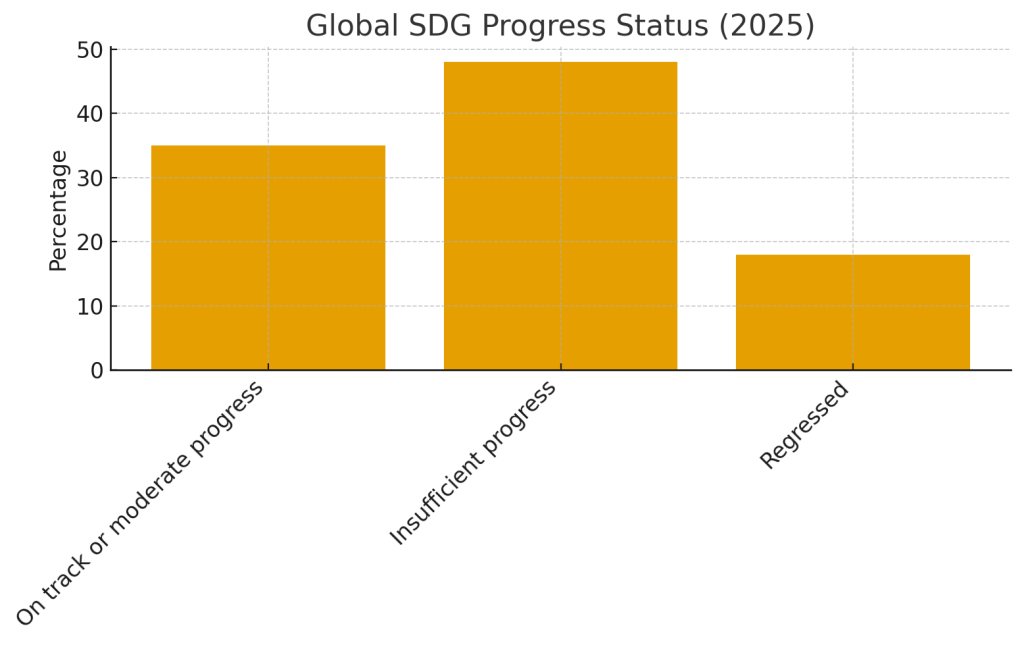
Across the 169 SDG targets, only about 35 percent are on track or showing moderate progress. Almost half are progressing too slowly and nearly one in five have actually slipped backward since 2015. These numbers are not just developmental setbacks, they are warning signs of deeper governance weaknesses, rising inequality, conflict recurrence and climate stress.
The SDGs Were Designed as a Framework for Peace
When UN Member States adopted the 2030 Agenda, they did more than outline development priorities. They recognized that peace, governance, justice and strong institutions are inseparable from human well-being. SDG 16 sits at the center of this logic, but governance principles run through nearly every goal.
The idea was simple but profound: there can be no sustainable development without peace and no peace without inclusive accountable governance. Today’s stagnation therefore raises urgent questions about political will, global cooperation, inequalities and the health of social contracts worldwide.
The Current State of Progress
The 2025 SDG report paints a sobering picture. Among the goals falling behind are poverty eradication, food security, climate action, gender equality, and inclusive societies. The areas mentioned are connected to stability and conflict prevention.
Some successes stand out. For instance, access to electricity has expanded. Preventable child deaths have declined. Digital connectivity has grown. But these gains are fragile, uneven and too often overshadowed by regression in conflict-affected or low-income regions where shocks like climate, economic, or political can erase progress overnight.
A major challenge remains the global data gap. Nearly one third of SDG indicators still lack consistent or timely data, limiting governments’ ability to plan or adjust policies effectively.
Why Progress Has Stalled: The Structural Drivers
Conflicts and Fragility:
Countries experiencing conflict show the lowest rates of SDG progress. Violence destroys infrastructure, weakens institutions and erodes trust. Regression across hunger, justice, education and poverty is common in these settings.
Governance Weaknesses:
Corruption, lack of transparency, weak rule of law and exclusionary policies undermine the ability of states to deliver services or uphold rights. Inequality deepens when institutions fail to respond equitably.
The Global Financing Gap:
Developing countries face multi-trillion-dollar shortfalls in investment needed for SDG achievement. Rising debt, limited fiscal space and global financial volatility further restrict governments’ ability to act.
Climate Stress:
Climate change accelerates food insecurity, displacement and livelihood collapse. For fragile states, each climate shock is a multiplier of existing vulnerabilities.
Inequality and Social Exclusion:
Groups facing exclusion i.e. women, youth, migrants, people with disabilities, ethnic minorities are often the first to fall behind and the last to benefit from national growth.
A Peace and Governance Lens on SDG Stagnation
For institutions focused on peacebuilding, the SDGs should be read as early warning signals. When progress slows on justice, equality, or institutional capacity, the risk of instability grows. Strong governance is not a luxury, it is the foundation of development itself.
Countries with capable, transparent and inclusive institutions consistently show better SDG outcomes. Those without them face stagnation or decline. If the world is to reclaim the SDG agenda, peace and governance must move from the margins to the center.
What Must Happen Before 2030
Rebuild Global Solidarity:
Multilateral institutions, donors and governments must realign around SDG acceleration and peacebuilding. Financing must be more coordinated, climate funding must expand and fragile states must receive particular attention.
Strengthen Governance and Institutions:
This includes justice reform, anti-corruption measures, public-sector modernization, participatory planning and stronger local governments. Effective governance transforms political will into real progress.
Make Development Peace-Responsive:
National development strategies should anticipate conflict risks. Development projects must incorporate inclusion, social cohesion and community-level peacebuilding.
Prioritize Equity:
Countries need stronger social protection systems, gender equality initiatives, inclusive education and policies that guarantee participation for all.
Close the Financing Gap:
Domestic revenue reforms, increased concessional support, debt relief and private-sector incentives must work together to fill the investment shortfalls.
Strengthen Data Systems:
Timely, disaggregated data is essential for action. Better monitoring tools, early-warning systems and partnerships with researchers and civil society can help governments respond faster and more effectively.
Conclusion: The Window Is Narrowing, but Not Closed
The SDGs remain one of humanity’s most ambitious collective promises. But ambition alone is not enough. To meet the moment, the world must take seriously the signals the data is sending: conflicts are rising, institutions are strained, inequalities are widening and climate shocks are intensifying.
The failure to meet the SDGs is not just a development concern, it is a peace and governance challenge. The foundations of stability must be rebuilt with renewed commitment, smarter investments and deeper cooperation.
There is still time to restore momentum. The rains have begun to fall, but the flood is not inevitable. With the right decisions, the world can reinforce its foundations and honor the promise of 2030: a more peaceful, just and inclusive future for all.