
Author’s Note
At a time when the world continues to grapple with divisions, polarization, and fragile peace, the life of the late Rt. Hon. Raila Amollo Odinga offers lessons that go beyond Kenya’s borders. His story is one of courage, sacrifice, and unrelenting faith in dialogue, a reminder that leadership must always serve the greater good. As we reflect on his legacy, we find in it both inspiration and challenge: to put peace and the people before politics.
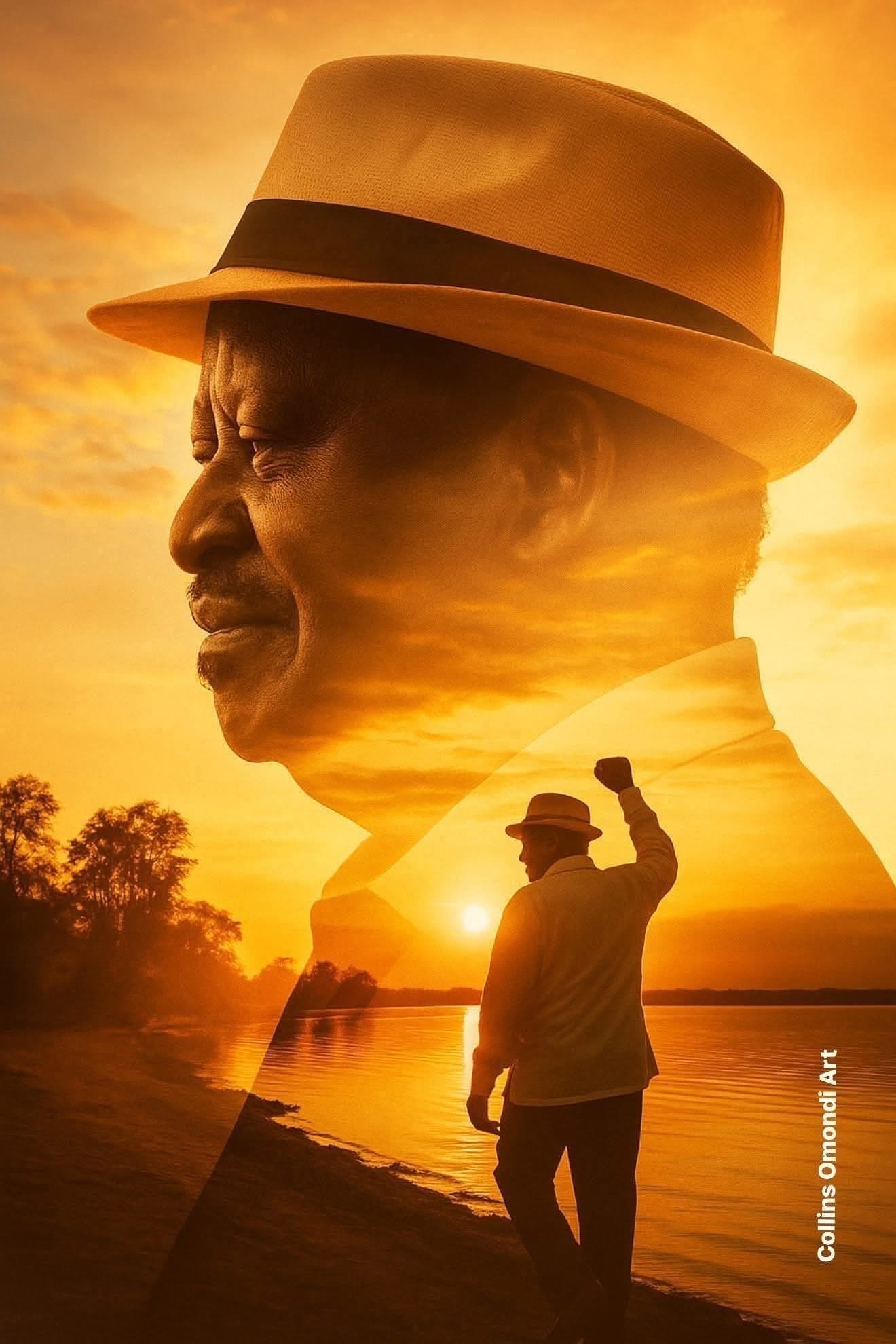
Picture credit: Collins Omondi
Across the ocean from where I am, Kenyans have lost their former Prime Minister. A man whose name became synonymous with resilience, reform, and reconciliation. Raila Amollo Odinga was not only a political leader; he was a symbol of endurance, hope, and the belief that peace is built, not declared. His journey through struggle and service left behind lessons that remain vital for leaders and citizens everywhere.
The Price of Conviction
Raila Odinga’s belief in a just and democratic Kenya came at great personal cost. In the 1980s, during the repressive one-party era, he was detained without trial for nearly nine years between 1982 and 1991. He endured solitary confinement, uncertainty, and separation from his family because he dared to speak for freedom and justice. Those were years of darkness for Kenya, yet Odinga emerged from them without bitterness. Instead of revenge, he chose reform; instead of silence, he chose to keep fighting for the rights of ordinary Kenyans.
His detention was not an isolated episode of defiance but a reflection of his enduring principle, that a better Kenya was worth every sacrifice. That moral conviction would later shape his approach to peace: not as an act of surrender, but as an expression of strength grounded in justice.
The National Peacemaker
When Kenya faced one of its most violent crises after the 2007 election, Odinga once again stood at crossroads. The country was burning; over a thousand lives lost, hundreds of thousands displaced, and a nation divided. He had every reason to walk away (from what), yet he chose dialogue.
Through negotiations led by former UN Secretary-General Kofi Annan, Odinga agreed to form a Grand Coalition Government with President Mwai Kibaki, becoming Prime Minister in 2008. It was an act of statesmanship, not concession. A decision to put Kenya’s survival above political pride. His leadership during that fragile transition helped calm tensions and allowed the country to begin rebuilding its social fabric.
Out of that moment emerged the 2010 Constitution, one of the most progressive in Africa. Its emphasis on devolution, equity, and inclusion reflected Odinga’s conviction that peace must be rooted in fairness. He understood that for Kenya to remain stable, every community needed a sense of belonging and a share in power.
Building Bridges and Healing Wounds
Raila Odinga’s legacy as a peacebuilder was further cemented in 2018 through his unexpected handshake with President Uhuru Kenyatta. The two men had been fierce political rivals, their contest threatening to deepen divisions across the country. Yet, in a moment of humility and foresight, they chose reconciliation.
That Handshake was not merely symbolic, it was a declaration that Kenya’s unity mattered more than political victory. It gave birth to the Building Bridges Initiative (BBI), an attempt to address structural injustices and promote national cohesion. Though the initiative faced challenges, its intent captured Odinga’s enduring message: that dialogue is not a sign of weakness but the essence of leadership in a diverse society.
A Continental Vision for Peace
Raila Odinga’s contribution to peace went far beyond Kenya. As the African Union High Representative for Infrastructure Development, he envisioned a connected continent where economic cooperation would underpin stability. He believed that roads, railways, and energy grids were not just projects of progress but instruments of peace. In his view, when nations trade and communicate, they build interdependence and with it, trust.
Odinga championed African-led solutions to African problems. He lent his voice to mediation efforts in South Sudan and advocated for reforms within the African Union to make it more effective in preventing conflict. His candidacy for the AU Commission Chairmanship in 2025 was a continuation of this mission; a call for unity, good governance, and home-grown peacebuilding grounded in African realities.
A Global Voice of Moral Leadership
On the global stage, Raila Odinga stood as a moral voice from the Global South. A statesman shaped by struggle, yet guided by principle. He understood that peace is sustained not only through treaties but through trust and justice. His leadership carried credibility because it was born of lived experience. Having endured repression, he valued freedom; having witnessed violence, he valued reconciliation.
He reminded the world that democracy and peace are inseparable, that societies which silence their citizens eventually silence their own progress. His message resonated beyond Africa because it was deeply human: peace begins when leaders choose empathy over ego, and when politics becomes a service, not a weapon.
Lessons for a Restless World
Raila Odinga’s journey offers enduring lessons for today’s leaders and citizens alike. First, peace demands sacrifice. He bore imprisonment and persecution so that future generations could live in freedom. Second, peace requires humility. Twice in his career, he put national unity above personal ambition, a rare act of statesmanship in a polarized world.
Third, peace must rest on justice. His advocacy for constitutional reform and devolution recognized that without fairness, stability is fleeting. And finally, peace depends on empathy. His humanity, humor, and capacity to forgive transformed politics from a contest of power into a dialogue about people’s lives.
The Legacy of a Bridge-Builder
As Kenya and the world mourn Raila Amollo Odinga, his story stands as both a mirror and a map. It reminds us of what leadership can be when anchored in service and moral clarity. He showed that peace is not an event but a lifelong practice. A commitment renewed in moments of crisis, often at great personal cost.
From the confines of a prison cell to the corridors of continental diplomacy, Odinga remained guided by one simple truth: that the purpose of leadership is to serve the people, and the purpose of politics is to make peace possible.
His passing leaves a deep void, but also a living challenge to leaders, to policymakers, to ordinary citizens, to place peace and humanity at the center of public life. Because as Raila Amollo Odinga taught through both word and deed, nations are not defined by the power they wield, but by the peace they build.
A great insight. Rt. Hon. Raila Amolo Odinga, C.G.H will be missed in the Kenyan history. May his soul rest in eternal peace.